Data visualizations improve patient insight in the Digital Clinic's eight-week treatment program
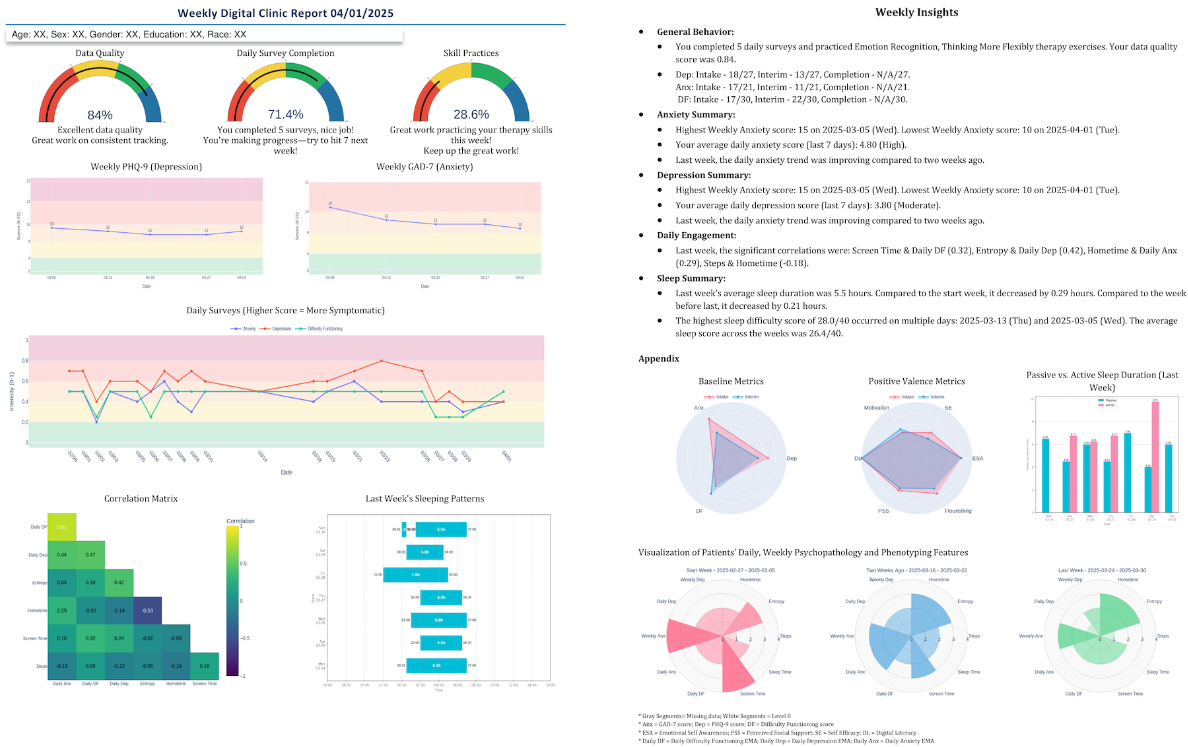
A paper published in the Journal of Participatory Medicine describes how the Division of Digital Psychiatry developed a set of data visualizations for use in its Digital Clinic, an eight-week virtual treatment program for adults with anxiety or depression, and documents how those visualizations supported patient engagement and self-management in practice.
The study, led by Katherine Lim and co-authored by Dr. John Torous, addressed a core challenge in digital mental health: smartphones used for clinical monitoring can generate enormous volumes of behavioral data, but converting that data into something clinicians and patients can actually use during a session has remained difficult. The team worked with 15 clinicians and three clinical supervisors through four rounds of iterative design to produce six visualization types, including symptom trajectory graphs, sleep charts, and correlation matrices linking behavior patterns to self-reported mood.
The visualizations were delivered through the Digital Clinic's Digital Navigator workflow, where trained non-clinical staff meet weekly with patients to review reports, explain trends, and help patients connect patterns in their data to their daily experience. The paper traces a single clinical case across the eight-week program, showing how one patient progressed from being introduced to the charts in early sessions to independently generating predictions about his own symptom patterns by week six.
The authors note that the patient remained engaged with the weekly visual reports even after his use of app-based exercises dropped to zero in the final week, suggesting the visualizations may help sustain connection to treatment during periods of lower formal engagement. Code used to generate the visualizations is available through the Cortex open-source software package.
The full paper is available at https://jopm.jmir.org/2026/1/e90255/
Enjoyed this article?
Subscribe for monthly updates on our research, platforms, and programs.